
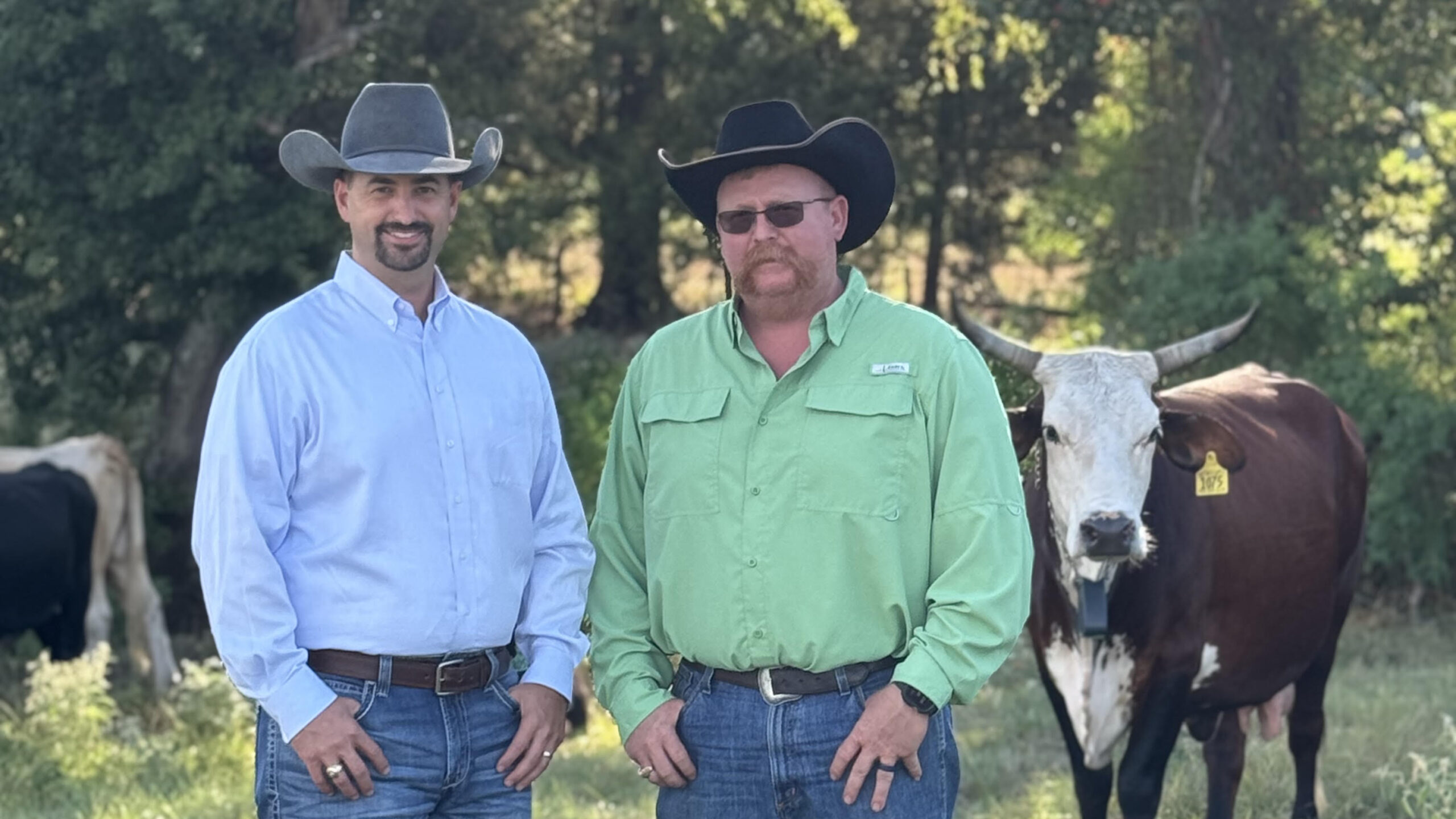
Rotational grazing has been proven, time and again, to rebuild soil, grow better forage, and carry more cattle on less acreage. The problem has never been whether it works — it’s the labor it demands. Constantly fixing fences, checking pastures, and keeping cattle contained is a full-time job on its own; which is why so many ranchers default to simple, continuous grazing and set stocking rates instead. Eric Yates and Chris Osborn, who run a partnership operation out of Longview, Texas, have taken a different approach. By pairing an intensive rotational system with Nofence virtual collars, they’ve turned what used to be the hardest part of rotational grazing — the constant physical labor — into a job that can be managed simply from a phone.
Two Ranchers, One Reputation
Yates has been in the cattle business since he was 12 years old, when he got his first cows. In the fall of 2020, in the middle of COVID-era, he and his wife Kelsey bought their property in Longview. Two years later, in the fall of 2022, he partnered with Chris Osborn, who had already been ranching his own property right down the road for 15 years and had taken over his family’s operation back in 2015. Together, Yates and Osborn run a cow/calf operation, plus a small number of beef cattle they finish out for friends and family.
Part of what pushed them toward virtual fencing was its practicality. In a region where land is steadily being lost to urbanization and infrastructure, holding onto grazing ground has become harder every year. Yates and Osborn have managed to keep, and grow, their leased and owned acreage largely because of their reputation for conservation-minded land stewardship. Nofence, a GPS-based virtual collar system, became the tool that let them manage more intensively without needing more hands or more physical fence.
Inside the Daily Rotation
The system is straightforward in concept: cattle wear GPS collars, and Yates and Osborn draw digital paddock boundaries from an app instead of building physical ones. The herd gets trained to respect the invisible line through a combination of audio cues and mild correction and, once trained, the collars do the containing.
Their rotation isn’t on a fixed calendar, it moves with the grass. Yates and Osborn monitor forage and cattle body condition daily and typically move the herd once about half the standing forage in a paddock has been grazed. In spring, that can mean daily moves to maximize impact on the ground; by late summer, moves stretch to every three to five days. Cattle currently get roughly five acres a day, a ladder-grazing system through multiple pastures and cycling back within about seven days to let regrowth catch up.
Rest periods are driven by their forage base — mostly improved Bermuda and Bahia grasses that grow fast but lose nutritional value just as fast once mature. To capture the grass at its best, they keep rest periods to around 35 days in spring and under 50 days by late summer.
The stocking density tells its own story of progress. Traditional set-stocking in East Texas calls for three to four acres per cow, with hay feeding for four to five months of the year. Moving to poly wire dropped that to about two acres per cow. With Nofence, they’re down to roughly 1.5 acres per cow — and land that used to carry 40 cows now supports 150, with Yates saying they still don’t have enough cattle to fully utilize the grass they’re growing.
The Numbers — and the Grass
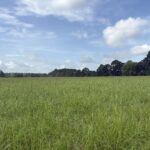
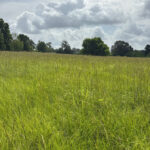
The numbers back up what they’re seeing on the ground. Winter hay needs have dropped to about 45 days a year, and in 2024 thanks to strong cool-season forage, they only fed hay for 38 days. They haven’t applied any commercial fertilizer to their grazing pastures since 2023, relying instead on rest and rotation to rebuild soil and root structure. Now they’re seeing pastures once choked with goat weed, blackberry, and briars turn into productive native grass fields through a combination of virtual fencing, targeted plantings, and prescribed fire.
Retention has been remarkably tight with Yates reporting a 99.7% efficiency keeping cattle inside their marked pastures. And the benefits go beyond cattle. Their more intensive, rest-based grazing has brought a visible increase in wildlife: more deer, bobcats, foxes, and a wider diversity of birds and pollinators than before.
Labor is where the shift shows up most in daily life. Fence fixing and running poly wire have nearly disappeared from their task list. Gates that once required constant opening and shutting now just stay open; the collars keep cattle where they belong regardless. Searching for cows and calves during calving season, a job that used to take hours, is now largely handled by the collars’ real-time location tracking. As Osborn put it, this year’s calving season became the clearest example yet of what the technology has meant. Instead of walking pastures looking for a cow in trouble, they can see instantly if one is off by herself and go straight to her.
From Skeptic to Believer
Neither man came to this as an easy believer. Yates is candid that in 2019, he was one of the skeptics who said virtual fencing would never work. It wasn’t until 2021, after stumbling onto a podcast on the subject, that he went “down a rabbit hole” researching it and came out the other side convinced it would reshape the cattle industry.
That skepticism, he says, is still the industry norm. In his words, there’s “a status quo for the cattle industry” built around barbed wire, and the region’s reliable rainfall has a way of masking bad management for a long time. He also points out that the real barrier to rotational grazing was never the concept — it’s proven itself repeatedly — but the labor it demands. Virtual fencing, in his view, is what removes that hurdle.
The ranchers haven’t done this alone, either. They leaned on a handful of conservation programs to help make goals achievable — the Legacy Landscapes initiative program through the Legacy Landscapes program through the National Grazing Lands Coalition (NatGLC), Agriwebb, and Alltech, funded by a public-private partnership between the Natural Resources Conservation Service (NRCS), Nestle Purina, Ahold Delhaize, Restaurant Brands International, and Wendy’s, with technical assistance provided by the Wildlife Habitat Federation (WHF) in Texas. Yates and Osborn credits these partnerships with taking some of the financial risk out of trying something outside the norm, giving them a safety net of program funding and technical support while they experiment with methods most neighbors haven’t touched yet.
The Bigger Picture
For Yates and Osborn, this isn’t just about their own acreage. It’s a response to a labor shortage that’s squeezing ranchers across the industry, and a bet that regenerative, rest-based grazing paired with technology like Nofence is where cattle production is headed. Their philosophy extends even to land they don’t own outright — Yates says his rule for leased property is simple: leave it worth more than it was when they got there.
“People who understand grazing understand the virtual collars,” he says, a line that doubles as a summary of this operations whole approach. The tools are only as good as the management behind them.
A Glimpse of Ranching’s Future
Rotational grazing has always worked on paper. What’s kept it out of reach for most ranchers is the labor it demands, and that’s exactly the barrier Yates and Osborn have removed. Their operation is proof that the constraint was never the method, it was the manpower, and technology like Nofence has closed that gap. As more ranchers face the same labor pressures squeezing the industry, Yates and Osborn’s bet is that the ones who adapt won’t be the ones with the most acreage or the most cattle — they’ll be the ones who figured out how to manage what they have without needing more hands to do it.
Written by Kylie Waller, Conservationist









About Post Author
